Mandala,mandala gallery,art pillows,mugs,art lamp,notebook,ceramic ornament,art towels,art candles,tapestry,what are mandalas,mandala project,mandala coloring,new mandalas, mandala designs,mandala art,printable mandala,free mandala,the mandala, color mandala,what is a mandala,mandala,the artist gallery,abstract paintings,vintage paintings,photofraphies,famous paintings,graphites,budhism,meditation,about color,alternative,famous quotes,ancient mandala,jewelry,art,reproductions....
Pages
- Home
- Mandala gallery
- Mandala art
- Art on the wall
- Mandala on canvas
- Mandala jewelry
- Fine Art America
- Abstract paintings
- Vintage Mandala
- Personal Mandala
- Mandala art
- What is Mandala?
- Meditation books
- Inspiration quotes
- Flower Mandalas
- Poster
- Tibetan mandalas
- Sri Yantra mandalas
- Chakra Mandalas
- Earrings
- Necklaces
- Rings
- Bracelets
- Buddha paintings
- Free Mandala
- What are mandalas?
- Art
- Symbolism
- Abstract art
- Links
Monday, April 29, 2013
Wednesday, April 17, 2013
Sunday, April 14, 2013
Tuesday, April 9, 2013
Flower of life
Flower of life
The Flower of Life is the name coined by New Age author Drunvalo Melchizedek for a geometrical figure composed of multiple evenly-spaced,
overlapping circles. This figure,
used as a decorative motiv since ancient times, forms a flower-like pattern with the symmetrical structure of a hexagon.
A
"Flower of Life" figure consists of seven or more overlapping
circles, in which the center of each circle is on the circumference of up to
six surrounding circles of the same diameter. However, the surrounding circles
need not be clearly or completely drawn; in fact, some ancient symbols that are
claimed as examples of the Flower of Life contain only a single circle or
hexagon.
New Age
followers ascribe many forms of significance to the Flower of Life and three
similar figures, called the "Egg of Life," the "Fruit of
Life," the "Seed of Life,"and the "Tree of Life."
Melchizedek and others assert that these figures are symbols of sacred geometry, that they represent
ancient spiritual beliefs, and that they depict fundamental aspects of space
and time. They claim that Metatron's
Cube may be derived from the
Flower of Life pattern, and that the Platonic
solids within it were
"thought to act as a template from which all life springs."
The Flower
of Life and the Seed of Life are linked by New Age authors with the Biblical
prophet Enoch, the Archangel Metatron, the six days of Creation, the Vesica Piscis religious symbol, and Borromean rings.
Friday, April 5, 2013
Thursday, April 4, 2013
Tuesday, April 2, 2013
Lakshmi
Lakshmi
Hindu art
Lakshmi is the Hindu
Goddess of wealth, prosperity
(both material and spiritual), fortune, and the embodiment of beauty. She is
the consort of the God Vishnu.
Also called Mahalakshmi, she is said to bring good
luck and is believed to protect
her devotees from all kinds of misery and money-related sorrows. Representations of Lakshmi are also
found in Jain monuments.
Lakshmi
is called Shri or Thirumagal because she is endowed with six auspicious
and divine qualities, or Gunas,
and also because she is the source of strength even to Vishnu. When Vishnu
incarnated on earth as avatars Rama and
Krishna, Lakshmi incarnated as his consort. Sita (Rama's wife), Radha (Krishna's lover) and Rukmini and Satyabama are considered forms of Lakshmi.
Lakshmi
is worshipped daily in Hindu homes and commercial establishments as the goddess
of wealth. She also enjoys worship as the consort of Vishnu in many temples.
The festivals of Diwali and Kojagiri
Purnima are celebrated in her
honour.
Vishnu
Vishnu
Hindu art
Vishnu is a Vedic Supreme God (including his different avatars) in Hinduism, and is venerated as the Supreme
Being in Vaishnavism. He is also known as Narayana or Hari and is venerated as Purushottama or SupremePurusha in Vedic sacred texts like the Bhagavad Gita, the Vedas and the Puranas. He is the Supreme Purusha of Purusha
Sukta.The Vishnu Sahasranama of the Mahabharata declares Vishnu as Paramatman (supreme soul) andParameshwara (supreme God). It describes Vishnu as
the All-Pervading essence of all beings, the master of—and beyond—the past,
present and future, the creator and destroyer of all existences, one who
supports, sustains and governs the Universe and originates and develops all
elements within.
Vaishnavism sees
Vishnu as the Supreme God, venerated as the Supreme
Being. Smarta followers of Adi Shankara, among others, venerate
Vishnu as just one of the five
primary forms of God, namely Shiva,
Vishnu, Devi, Surya and Ganesha; who are all seen as equal
reflections of the one Brahman, rather than as distinct beings. His supreme
status is declared in Hindu sacred texts like the Yajurveda, the Rigveda the Bhagavad
Gita, The Bhagavata Purana and other Sattva Puranas which all declare Vishnu as Supreme
God. Vishnu incarnates on planet
Earth from time to time to eradicate evil forces, to restore the Dharma and to liberate the worthy ones or
devotees from the cycle of births and deaths.
In the Puranas,
Vishnu is described as having the divine blue colour of water-filled clouds and
as having four arms. He is depicted as holding a padma or lotus flower in the lower left
hand, a gada or mace in the lower right hand, a shankha or conch in the upper left hand and a Sudarshana Chakra or discus weapon in the upper right
hand. Vishnu is also described in the Bhagavad Gita as having a 'Universal
Form' (Vishvarupa or Viraat Purusha) which is beyond
the ordinary limits of human perception or imagination.
Vishnu's eternal and supreme abode beyond the material
universe is called Vaikuntha,
which is also known as Paramdhama, the realm of eternal bliss and happiness,
for the final or highest place for liberated souls. Vaikuntha is situated
beyond the material universe and hence, cannot be perceived or measured by
material science and logic.Vishnu's other abode within the material universe is Ksheera Sagara (the ocean of milk), where he reclines
and rests on Ananta Shesha. It is
the topmost realm in the material universe, even higher than Satyaloka where Brahma resides. Vishnu manages and
sustains the universe from there. Hence, Ksheera Sagara is also sometimes known
as local Vaikuntha of the material universe, which is approachable by demigods
or devas in order to meet the lord in case of any emergency or disturbance in
universal balance.
Ganesha - Hindu art
Ganesha - Hindu art
Ganesha also known as Pillaiyar, Ganapati and Vinayaka, is one of the best-known and most widely worshipped
deities in the Hindu pantheon. His image is found throughout India and Nepal. Hindu sects worship him regardless of affiliations.
Devotion
to Ganesha is widely diffused and extends to
Jains, Buddhists, and beyond India.
Although
he is known by many other attributes, Ganesha's elephant head makes him particularly easy to
identify. Ganesha
is widely revered as the Remover of Obstacles and
more generally as Lord of Beginnings and Lord of Obstacles, patron of arts and sciences, and the deva of
intellect and wisdom. He is
honoured at the beginning of rituals and ceremonies and invoked as Patron of
Letters during writing sessions. Several
texts relatemythological anecdotes associated
with his birth and exploits and explain his distinct iconography.
Ganesha
emerged as a distinct deity in clearly recognizable form in the 4th and 5th
centuries CE, during the Gupta
Period, although he inherited traits from Vedic and pre-Vedic precursors. His popularity rose quickly, and he
was formally included among the five primary deities of Smartism (a Hindu denomination) in the 9th
century. A sect of devotees called the Ganapatya
(Sanskrit: गाणपत्य; IAST: gāṇapatya), who identified
Ganesha as the supreme deity, arose during this period. The principal scriptures dedicated to
Ganesha are the Ganesha Purana,
the Mudgala Purana, and the Ganapati Atharvashirsa.
Tuesday, March 26, 2013
Christian Mandala
Christian Mandala
Forms which
are evocative of mandalas are prevalent in Christianity: the celtic cross; the rosary; the halo; the aureole; oculi; theCrown of Thorns; rose windows; the Rosy Cross; and the dromenon on the floor of Chartres Cathedral. The dromenon
represents a journey from the outer world to the inner sacred centre where the
Divine is found.
Similarly, many of the
Illuminations of Hildegard von
Bingen can be used as mandalas,
as well as many of the images of esoteric
Christianity, as in Christian Hermeticism, Christian Alchemy, and Rosicrucianism.
Friday, November 30, 2012
Purple flower Mandala
Acrylic on paper
"You can go on changing the outer for lives and you will never be satisfied; something or other will remain to be changed. Unless the inner changes, the outer can never be perfect."
"When love and hate are both absent everything becomes clear and undisguised."
Osho
Blue flower Mandala
Blue flower Mandala
"Intelligence is a natural phenomenon -- just as breathing is, just as
seeing is. Intelligence is the inner seeing; it is intuitive. It has nothing to
do with intellect. Never confuse intellect with intelligence, they are polar
opposites. Intellect is of the head; it is taught by others, it is imposed on
you. You have to cultivate it. It is borrowed, it is something foreign, it is
not inborn. But intelligence is inborn. It is your very being, your very
nature."
Osho
Pink wheel Mandala
Pink wheel Mandala
Acrylic on paper
"All the Buddhas of all the ages have been telling you a very simple
fact: Be -- don't try to become. Within these two words, be and becoming, your
whole life is contained. Being is enlightenment, becoming is ignorance."
"If you wish to see the truth, then hold no opinion for or against."
"To be creative means to be in love with life. You can be creative only if you love life enough that you want to enhance its beauty, you want to bring a little more music to it, a little more poetry to it, a little more dance to it."
Osho
Yellow Moon
Yellow Moon
Acrylic on paper
"Mind can accept any boundary anywhere. But the reality is that, by its very nature, existence cannot have any boundary, because what will be beyond the boundary - again another sky. That's why I'm saying skies upon skies are available for your flight. Don't be content easily. Those who remain content easily remain small: small are their joys, small are their ecstasies, small are their silences, small is their being. But there is no need! This smallness is your own imposition upon your freedom, upon your unlimited possibilities, upon your unlimited potential."
Osho
Monday, November 26, 2012
Chakras in Buddhist Tantra
Chakras
Chakras play an important role in the main surviving branch of Indian Vajrayana, Tibetan Buddhism. They play a pivotal role in completion stage practices, where an attempt is made to bring the subtle winds of the body into the central channel, to realise the clear light of bliss and emptiness, and to attain Buddhahood.
The Vajrayana system states that the central channel (avadhūtī) begins at the point of the third eye, curves up to the crown of the head, and then goes straight down to the lower body. There are two side channels, the rasanā and lalanā, which start at their respective nostrils and then travel down to the lower body. The apāna vāyu governs the lower terminations of the three channels. The lower end of the central channel ends in the rectum. The lower end of the lalanā ends in the urinary tract. The lower end of the rasanā channel emits semen.
The side channels run parallel to the center channel, except at locations such as the navel, heart, throat and crown where the two side channels twist around the central channel. At the navel, throat and crown, there is a twofold knot caused by each side channel twisting once around the central channel. At the heart wheel there is a sixfold knot, where each side channel twists around three times. An important part of completion stage practice involves loosening and undoing these knots.
Within the chakras exist the 'subtle drops'. The white drop exists in the crown, the red drop exists in the navel, and at the heart exists the indestructible red and white drop, which leaves the body at the time of death. In addition, each chakra has a number of 'spokes' or 'petals', which branch off into thousands of subtle channels running to every part of the body, and each contains a Sanskrit syllable.
By focusing on a specific chakra (while often holding the breath) the subtle winds enter the central channel. The chakra at which they enter is important in order to realise specific practices. For example, focusing on the subnavel area is important for the practice of tummo, or inner fire. Meditating on the heart chakra is important for realizing clear light. Meditating on the throat chakra is important for lucid dreaming and the practices of dream yoga. And meditating on the crown chakra is important for consciousness projection, either to another world, or into another body.
A result of energetic imbalance among the chakras is an almost continuous feeling of dissatisfaction. When the heart chakra is agitated, people lose touch with feelings and sensations, and that breeds the sense of dissatisfaction. That leads to looking outside for fulfillment. When people live in their heads, feelings are secondary; they are interpretations of mental images that are fed back to the individual. When awareness is focused on memories of past experiences and mental verbalisations, the energy flow to the head chakra increases and the energy flow to the heart chakra lessens. Without nurturing feelings of the heart a subtle form of anxiety arises which results in the self reaching out for experience.
When the throat chakra settles and energy is distributed evenly between the head and the heart chakras, one is able to truly contact one's senses and touch real feelings.
Gautama Buddha
Gautama Buddha
Gautama Buddha or Siddhārtha Gautama Buddha ( Pali: Siddhattha Gotama) was a spiritual teacher from the Indian subcontinent , on whose teachings Buddhism was founded.
The word Buddha is a title for the first awakened being in an era. In most Buddhist traditions, Siddhartha Gautama is regarded as the Supreme Buddha (P. sammāsambuddha, S. samyaksaṃbuddha) of our age, "Buddha" meaning "awakened one" or "the enlightened one." Gautama Buddha may also be referred to as Śākyamuni. Gautama taught a Middle Way compared to the severe asceticism found in the Sramana (renunciation) movement common in his region. He later taught throughout regions of eastern India such as Magadha and Kośala.
The time of Gautama's birth and death are uncertain: most early-20th-century historians dated his lifetime as circa 563 BCE to 483 BCE, but more recent opinion dates his death to between 486 and 483 BCE or, according to some, between 411 and 400 BCE.
Gautama is the primary figure in Buddhism, and accounts of his life, discourses, and monastic rules are believed by Buddhists to have been summarized after his death and memorized by his followers. Various collections of teachings attributed to him were passed down by oral tradition, and first committed to writing about 400 years later.
Sunday, November 25, 2012
Mandala
Mandala
Mandala is a Sanskrit word meaning "circle." In the Buddhist and Hindu religious traditions sacred art often takes a mandala form. The basic form of most Hindu and Buddhist mandalas is a square with four gates containing a circle with a center point. Each gate is in the shape of a T. Mandalas often exhibit radial balance.
TheThese se mandalas, concentric diagrams, have spiritual and ritual significance in both Buddhism and Hinduism. The . The term is of term is of Hindu origin and appears in the Rig Veda as the name of the sections of the work, but is also used in other Indian religions, particularly Buddhism. In the Tibetan branch of Vajrayana Buddhism, mandalas have been developed into sandpainting. They are also a key part of anuttarayoga tantra meditation practices.
In various spiritual traditions, mandalas may be employed for focusing attention of aspirants and adepts, as a spiritual teaching tool, for establishing a sacred space, and as an aid to meditation and trance induction. According to the psychologist David Fontana, its symbolic nature can help one "to access progressively deeper levels of the unconscious, ultimately assisting the meditator to experience a mystical sense of oneness with the ultimate unity from which the cosmos in all its manifold forms arises." The psychoanalyst Carl Jung saw the mandala as "a representation of the unconscious self," and believed his paintings of mandalas enabled him to identify emotional disorders and work towards wholeness in personality.
In common use, mandala has become a generic term for any plan, chart or geometric pattern that represents the cosmos metaphysically or symbolically, a microcosm of the universe from the human perspective.
Mandala
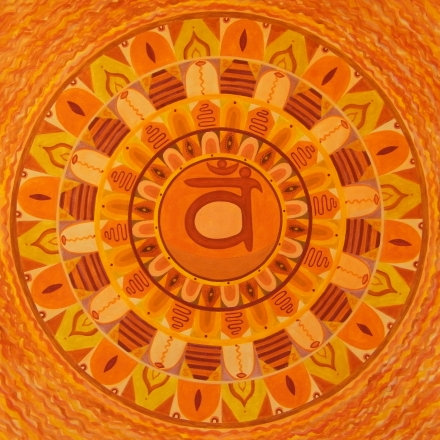
Second Chakra Mandala
Acrylic on paper
Swadhisthana, Svadisthana or Adhishthana is symbolised by a white lotus within which is a crescent moon, with six vermillion, or orange petals. The seed mantra is Vam, and the presiding deity is Brahma, with the Shakti being Rakini (or Chakini). The animal associated is the crocodile of Varuna.
The Sacral Chakra is located in the sacrum (hence
the name) and is considered to correspond to the testes or the ovaries that
produce the various sex hormones involved
in the reproductive cycle.
Swadisthana is also considered to be related to, more generally, the genitourinary
system and the adrenals. The key issues involving Swadisthana are
relationships, violence, addictions, basic emotional needs, and pleasure.
Physically, Swadisthana governs reproduction, mentally it governs creativity,
emotionally it governs joy, and spiritually it governs enthusiasm.
Subscribe to:
Posts (Atom)


3.jpg)