Sunday, November 25, 2012

Mandala


Mandala


Mandala is a Sanskrit word meaning "circle." In the Buddhist and Hindu religious traditions sacred art often takes a mandala form. The basic form of most Hindu and Buddhist mandalas is a square with four gates containing a circle with a center point. Each gate is in the shape of a T. Mandalas often exhibit radial balance.
TheThese se mandalas, concentric diagrams, have spiritual and ritual significance in both Buddhism and Hinduism. The . The term is of term is of Hindu origin and appears in the Rig Veda as the name of the sections of the work, but is also used in other Indian religions, particularly Buddhism. In the Tibetan branch of Vajrayana Buddhism, mandalas have been developed into sandpainting. They are also a key part of anuttarayoga tantra meditation practices.
In various spiritual traditions, mandalas may be employed for focusing attention of aspirants and adepts, as a spiritual teaching tool, for establishing a sacred space, and as an aid to meditation and trance induction. According to the psychologist David Fontana, its symbolic nature can help one "to access progressively deeper levels of the unconscious, ultimately assisting the meditator to experience a mystical sense of oneness with the ultimate unity from which the cosmos in all its manifold forms arises." The psychoanalyst Carl Jung saw the mandala as "a representation of the unconscious self," and believed his paintings of mandalas enabled him to identify emotional disorders and work towards wholeness in personality.
In common use, mandala has become a generic term for any plan, chart or geometric pattern that represents the cosmos metaphysically or symbolically, a microcosm of the universe from the human perspective.


Mandala 

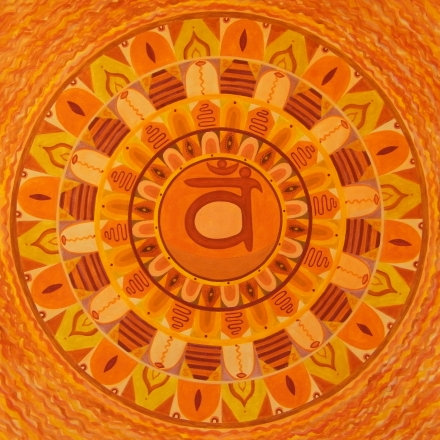
Second Chakra Mandala


Second Chakra Mandala
Acrylic on paper


Swadhisthana
, Svadisthana or Adhishthana
 is symbolised by a white lotus within which is a crescent moon, with six vermillion, or orange petals. The seed mantra is Vam, and the presiding deity is Brahma, with the Shakti being Rakini (or Chakini). The animal associated is the crocodile of Varuna.
The Sacral Chakra is located in the sacrum (hence the name) and is considered to correspond to the testes or the ovaries that produce the various sex hormones involved in the reproductive cycle. Swadisthana is also considered to be related to, more generally, the genitourinary system and the adrenals. The key issues involving Swadisthana are relationships, violence, addictions, basic emotional needs, and pleasure. Physically, Swadisthana governs reproduction, mentally it governs creativity, emotionally it governs joy, and spiritually it governs enthusiasm.

Mantrayana and Vajrayana


Mantrayana and Vajrayana


Although the Vajrayana claims to be as ancient and authentic as any other Buddhist school, it may have grown up gradually such as the mahasannipata and the ratnaketudharani. The . The basic positionbasic position of Vajrayana is still the same as the early Buddhist position of not-self: there is nothing which is eternal. The re is nothing which is eternal. The changes that took place reflectedchanges that took place reflected the changing society of medieval India: the presentation changed, the techniques of the way to enlightenment changed, and the outward appearance of Buddhism came to be dominated by ritualism, and the array of Buddhas, Bodhisattvas, and gods and goddesses.
There are differing views as to where in the Indian sub-continent that Vajrayana began. There are assumptions about the origin of Vajrayana in Bengal, Uddiyana, located at Orissa, or in the modern day Swat Valley in Pakistan.
 Nalanda University in eastern India became a center for the development of Vajrayana theory, although it is likely that the university followed, rather than led, the early Tantric movement.
Only from the 7th or the beginning of the 8th century, tantric techniques and approaches increasingly dominated Buddhist practice in India. From the 7th century onwards many popular religious elements of a heterogeneous nature were incorporated into Mahayana Buddhism, which finally resulted in the appearance of Vajrayana, Kalachakrayana, and Sahajayana Tantric Buddhism. These new Tantric cults of Buddhism introduced Mantra, Mudra and Mandala, along with six tantric Abhicharas (practices) such as Marana (Death), Stambhana, Sammohana, Vidvesan, Uchchatana and Vajikarana. These cults revived primitive beliefs and practices, a simpler and less formal approach to the personal god, a liberal and respectful attitude towards women, and denial of the caste system.
India would continue as the source of leading-edge Vajrayana practices up until the 11th century, producing many renowned Mahasiddha.
(Vajrayana) Buddhism had mostly died out in India by the 13th century, and tantric versions of Buddhism and Hinduism were also experiencing pressure from invading Islamic armies. By that time, the vast majority of the practices were also manifest in Tibet, where they were preserved until recently.
In the second half of the 20th century a sizable number of Tibetan exiles fled the oppressive, anti-religious rule of the Communist Chinese to establish Tibetan Buddhist communities in northern India, particularly around Dharamsala.

First Chakra Mandala


First Chakra Mandala
Acrylic on paper 


Muladhara or root chakra is symbolised by a lotus with four petals and the color red. This center is located at the base of the spine in thecoccygeal region. It is said to relate to the gonads and the adrenal medulla, responsible for the fight-or-flight response when survival is under threat.
Muladhara is related to instinct, security, survival and also to basic human potentiality. Physically, Muladhara governs sexuality, mentally it governs stability, emotionally it governs sensuality, and spiritually it governs a sense of security. Muladhara has a relation to the sense of smell.
This chakra is where the three main nadis separate and begin their upward movement. Dormant Kundalini rests here, wrapped three and a half times around the black Svayambhu linga, the lowest of three obstructions to her full rising (also known as knots or granthis). It is the seat of the red bindu, the female drop (which in Tibetan vajrayana is located at the navel chakra).
The seed syllable is Lam (pronounced lum), the deity is Ganesh, and the Shakti is Dakini. The associated animal is the elephant.


Tibetan Buddhism


Tibetan Buddhism


Tibetan Buddhism is the body of Buddhist religious doctrine and institutions characteristic of Tibet and certain regions of the Himalayas, including northern Nepal, Bhutan, and India (particularly in Arunachal Pradesh, Ladakh, Dharamsala, Lahaul and Spiti in Himachal Pradesh, and Sikkim). It is the state religion of Bhutan. It is also practiced in Mongolia and parts of Russia (Kalmykia, Buryatia, and Tuva) and Northeast China. Texts recognized as scripture and commentary are contained in the Tibetan Buddhist canon, such that Tibetan is a spiritual language of these areas.
A Tibetan diaspora has spread Tibetan Buddhism to many Western countries, where the tradition has gained popularity. Among its prominent exponents is the 14th Dalai Lama of Tibet. The number of its adherents is estimated to be between ten and twenty million.
Tibetan Buddhism comprises the teachings of the three vehicles of Buddhism: the Foundational Vehicle, Mahāyāna, and Vajrayāna. The Mahāyāna goal of spiritual development is to achieve the enlightenment of Buddhahood in order to most efficiently help all other sentient beings attain this state. The motivation in it is the bodhicitta mind of enlightenment — an altruistic intention to become enlightened for the sake of all sentient beings. Bodhisattvas are revered beings who have conceived the will and vow to dedicate their lives with bodhicitta for the sake of all beings. Tibetan Buddhism teaches methods for achieving Buddhahood more quickly by including the Vajrayāna path in Mahāyāna.
Buddhahood is defined as a state free of the obstructions to liberation as well as those to omniscience. When, in Buddhahood, one is freed from all mental obscurations, one is said to attain a state of continuous bliss mixed with a simultaneous cognition of emptiness, the true nature of reality. In this state, all limitations on one's ability to help other living beings are removed.
It is said that there are countless beings who have attained Buddhahood. Buddhas spontaneously, naturally and continuously perform activities to benefit all sentient beings. However it is believed that one's karma could limit the ability of the Buddhas to help them. Thus, although Buddhas possess no limitation from their side on their ability to help others, sentient beings continue to experience suffering as a result of the limitations of their own former negative actions.


Buddhist meditation


Buddhist meditation refers to the meditative practices associated with the religion and philosophy of Buddhism.
 
 Core meditation techniques have been preserved in ancient Buddhist texts and have proliferated and diversified through teacher-student transmissions. Buddhists pursue meditation as part of the path toward Enlightenment and Nirvana. The closest words for meditation in the classical languages of Buddhism are bhāvanā and jhāna/dhyāna. Buddhist meditation techniques have become increasingly popular in the wider world, with many non-Buddhists taking them up for a variety of reasons.
 
Buddhist meditation encompasses a variety of meditation techniques that aim to develop mindfulness, concentration, supramundane powers, tranquility, and insight. Given the large number and diversity of traditional Buddhist meditation practices, this article primarily identifies authoritative contextual frameworks — both contemporary and canonical — for the variety of practices.


Marzipan Mandala


Marzipan Mandala


Let there be no purpose in friendship save the deepening of the spirit. For love that seeks aught but the disclosure of it's own mystery is not love but a net cast forth, and only the unprofitable is caught... And in the sweetness of friendship let there be laughter, and sharing of pleasures. For in the dew of little things, the heart finds it's morning and is refreshed. 


Kahlil Gibran- Spiritual Frienship


Transcendental Meditation


Meditation


Transcendental Meditation (TM) refers to a specific form of mantra meditation called the Transcendental Meditation technique and an organization called the Transcendental Meditation movement. The TM technique and TM movement were introduced in India in the mid-1950s by Maharishi Mahesh Yogi (1918–2008).
 
The Maharishi taught thousands of people during a series of world tours from 1958 to 1965, expressing his teachings in spiritual and religious terms. TM became more popular in the 1960s and 1970s, as the Maharishi shifted to a more scientific presentation and his meditation technique was practiced by celebrities. At this time he began training TM teachers and created specialized organizations to present TM to specific segments of the population such as business people and students. By the late 2000s, TM had been taught to millions of people, and the worldwide TM organization had grown to include educational programs, health products, and related services.
 
The TM technique involves the use of a sound or mantra and is practiced for 15–20 minutes twice per day. It is taught by certified teachers through a standard course of instruction but fees vary by country. It is said to be a means of relaxation and stress reduction. Skeptics question its scientific value while proponents say that Transcendental Meditation research indicates improved health, creativity, intelligence, and a positive influence on society. In 1977, a U.S. district court ruled that a curriculum in TM and the Science of Creative Intelligence that was being taught in some New Jersey schools was religious in nature and in violation of the First Amendment. The Transcendental Meditation technique has been variously described by sociologists and religious scholars as religious and non-religious. The characterizations and responses to the TM technique by governmental agencies has varied depending on the time period, specific agency, and country of origin.
 
TM is one of the most widely practiced, and among the most widely researched meditation techniques. Research reviews of the effects of the Transcendental Meditation technique show results ranging from inconclusive  to clinically significant.
The Transcendental Meditation (TM) program and the Transcendental Meditation movement originated with Maharishi Mahesh Yogi, founder of the organization, and continue beyond his death (2008). In 1955,the Maharishi began publicly teaching a traditional meditation technique learned from his master Brahmananda Saraswati, which he called Transcendental Deep Meditation., and later renamed Transcendental Meditation. 

The Maharishi initiated thousands of people, then developed a TM teacher training program as a way to accelerate the rate of bringing the technique to more people. He also inaugurated a series of world tours which promoted Transcendental Meditation. These factors, coupled with endorsements by celebrities who practiced TM, along with scientific research that validated the technique, helped to popularize the TM in the 1960s and 1970s. As well, in the 1970s advanced meditative techniques were introduced. By the late 2000s, TM had been taught to millions of individuals and the Maharishi was overseeing a large multinational movement.Despite organizational changes and additional techniques, the Transcendental Meditation technique has remained relatively unchanged.
 
Among the first organizations to promote TM were the Spiritual Regeneration Movement and the International Meditation Society. In present times, the movement has grown to encompass schools and universities that teach the practice, and includes many associated programs offering health and well-being based on the Maharishi's interpretation of the Vedic traditions. In the U.S., major organizations included Students International Meditation Society, AFSCI, World Peace Executive Council, Maharishi Vedic Education Corporation, and Global Country of World Peace. The successor to Maharishi Mahesh Yogi, and head of the Global Country of World Peace, is Tony Nader.
T
he Transcendental Meditation technique is a specific form of mantra meditation developed by Maharishi Mahesh Yogi  and often referred to as Transcendental Meditation or simply, TM. The meditation practice involves the use of a sound, called a mantra, and is practiced for 15–20 minutes twice per day, while sitting with closed eyes. The technique is reported to be one of the most widely practiced, and among the most widely researched, meditation techniques, with over 340 peer-reviewed studies published. Research reviews of the effects of the Transcendental Meditation technique have yielded results ranging from inconclusive to clinically significant. The technique is made available worldwide by certified TM teachers in a seven step course.
 
Beginning in 1965, the Transcendental Meditation technique was incorporated into selected institutional programs such as schools, universities and corporations, as well as social programs aimed at veterans, prison inmates and the homeless. In 1977, a U.S. district court ruled that a curriculum in TM and the Science of Creative Intelligence that was being taught in some New Jersey schools was religious in nature and in violation of the First Amendment. The technique has since been included in educational and social programs worldwide.
The Transcendental Meditation technique has been described as both religious and non religious, as an aspect of a New Religious Movement, as having roots in Hinduism, and by the TM movement as scientific and non-religious. Publicity campaigns for the TM technique have varied over a 50 year history. It has been praised for visibility in the mass media and effective global propagation, and criticized for turning its celebrity and scientific 
endorsements into propaganda. The fees for the TM course vary from country to country.
 
Advanced courses supplement the TM technique and include an advanced meditation called the TM-Sidhi program. In 1970, the Science of Creative Intelligence (SCI) became the theoretical basis for the Transcendental Meditation technique, although skeptics questioned its scientific nature. According to proponents, when 1 percent of a population (such as a city or country) practices the TM technique daily, their practice influences the quality of life for that population. This has been termed the Maharishi Effect.
 
The Transcendental Meditation movement (also referred to as Transcendental Meditation or TM, Maharishi's worldwide movement, and the Transcendental Meditation organization) is a worldwide organization, sometimes characterized as a neo-Hindu new religious movement, and also as non-religious, founded by Maharishi Mahesh Yogi in the 1950s. Estimated to have tens of thousands of participants, with high estimates citing as many as several million, the global organization also consists of close to 1,000 TM centers, and controls property assets of the order of USD 3.5 billion (1998 estimate), including real estate holdings, schools, and clinics.
 
The term Transcendental Meditation movement refers to programs and organizations connected to the Transcendental Meditation technique that were developed and or introduced by the founder. These programs include the TM-Sidhi program, Maharishi Ayurveda and Maharishi Sthapatya Veda. The TM-Sidhi program is an advanced form of Transcendental Meditation and includes "Yogic flying". Maharishi Ayurveda is an alternative system of health care that aims to restore balance in the physiology, eliminate impurities, and awaken the body's natural healing mechanisms. Maharishi Sthapatya Veda is a system of architectural and planning principles based on "ancient Sanskrit texts" The movement also operates numerous schools and universities, offers monastic programs called Mother Divine and Thousand Headed Purusha, operates health centers such as The Raj and Maharishi Ayurveda Health Center, assorted businesses such as Maharishi Ayurveda Products International and several TM-centered communities.
 
The first organization of the Transcendental Meditation movement was the Spiritual Regeneration Movement, founded in India in 1958. The International Meditation Society and Student International Meditation Society (SIMS) were founded in the US in the 1960s. The organizations were consolidated under the leadership of the World Plan Executive Council in the 1970s. In 1992, a political party, the Natural Law Party (NLP) was founded based on the principles of TM and it ran candidates in ten countries before disbanding in 2004. The Global Country of World Peace is currently one of the primary organizations.
The TM movement has been described as a spiritual movement, as a new religious movement, and a "Neo-Hindu" sect. It has been characterized as a religion, a cult, a charismatic movement, a "sect", "plastic export Hinduism", a progressive millennialism organization and a "multinational, capitalist, Vedantic Export Religion" in books and the mainstream press, with concerns that the movement was being run to promote the Maharishi's personal interests. 

Skeptics have called TM or its associated theories and technologies a pseudoscience. Other sources assert that TM is not a religion, but a meditation technique; and they hold that the TM movement is a spiritual organization, and not a religion or a cult. Participation in TM programs at any level does not require one to hold or deny any specific religious beliefs; TM is practiced by people of many diverse religious affiliations, as well as atheists and agnostics.


Saturday, November 24, 2012

How to Meditate on a Tibetan Mandala


 Meditation


Many times some form of visual aid or tool is preferred when meditating. This can help an individual focus during the meditation. Meaning "circle" in Sanskrit, a mandala can be used by an advanced practitioner as well as a beginner. It allows for relaxation and visualization.

What is a Mandala?

A mandala is a circular form made up of spiraling circles and interlinking squares which often features a deity in the middle.
A mandala can represent the order of the universe and allows for the integration of mind and spirit while allowing the exploration of different realms of consciousness. A mandala can be small and simple or huge and elaborate; some come in the form of a labyrinth.

How are Mandalas Made?

Mandalas are constructed in a few different ways. A mandala can be made on silk or painted on a scroll, which is known as a tangka. Another way to make a mandala is out of sand where at the end of the meditation, the sand is gently blown away.
A mandala can also be created by using yarn to form a three-dimensional sculpture or simply drawn and colored. There are also different internet sites which provide free printable mandala coloring pages in which the designs are already drawn and all one has to do is color in the design.

How to Meditate on a Mandala

Think of the mandala as taking a journey. Whereas most meditations are done with the eyes closed, a mandala meditation can be done with the eyes open. After finding a quiet, comfortable place to sit while keeping a good posture, begin to breath slowing and deeply.
Begin with the outside of the mandala and view it as a path that begins on the outside, then slowly makes its way to the middle, which is the goal of the meditation. Focus only on the shapes and colors, allowing yourself to soak in their beauty. In traditional Tibetan mandalas, the outside rings denote fire which is used to purify a person as the flames prepare an individual for meditation.
 
Continue to follow the path and don't worry if a dead end is reached. If this happens, simply go back and begin anew. The premise for this meditation is not just about reaching the center, it's also about the journey to get there.
The center of the mandala is known as the temple or palace. It should have something that contains a special significance to you. This could be in the form of a symbol or word. Once in the center, imagine no longer being separate from the mandala, but, becoming one with it.
Imagine the body and mind becoming one with the universe and all of the vast knowledge and wisdom the universe contains. When finished, slowly come out of the meditation and take a few moments to contemplate your experiences.
 
Meditating on a mandala is like taking a journey for relaxation along with allowing for a visualization accessory for the meditation. With deep roots in traditional Buddhist meditations, a mandala is a colorful tool which opens a path for combining the mind and body with the wisdom of the universe.