Tuesday, April 22, 2014

Friday, April 18, 2014

Mandala necklace with Night lily mandala


Night lily Mandala necklace


Night lily mandala

Acryl on paper


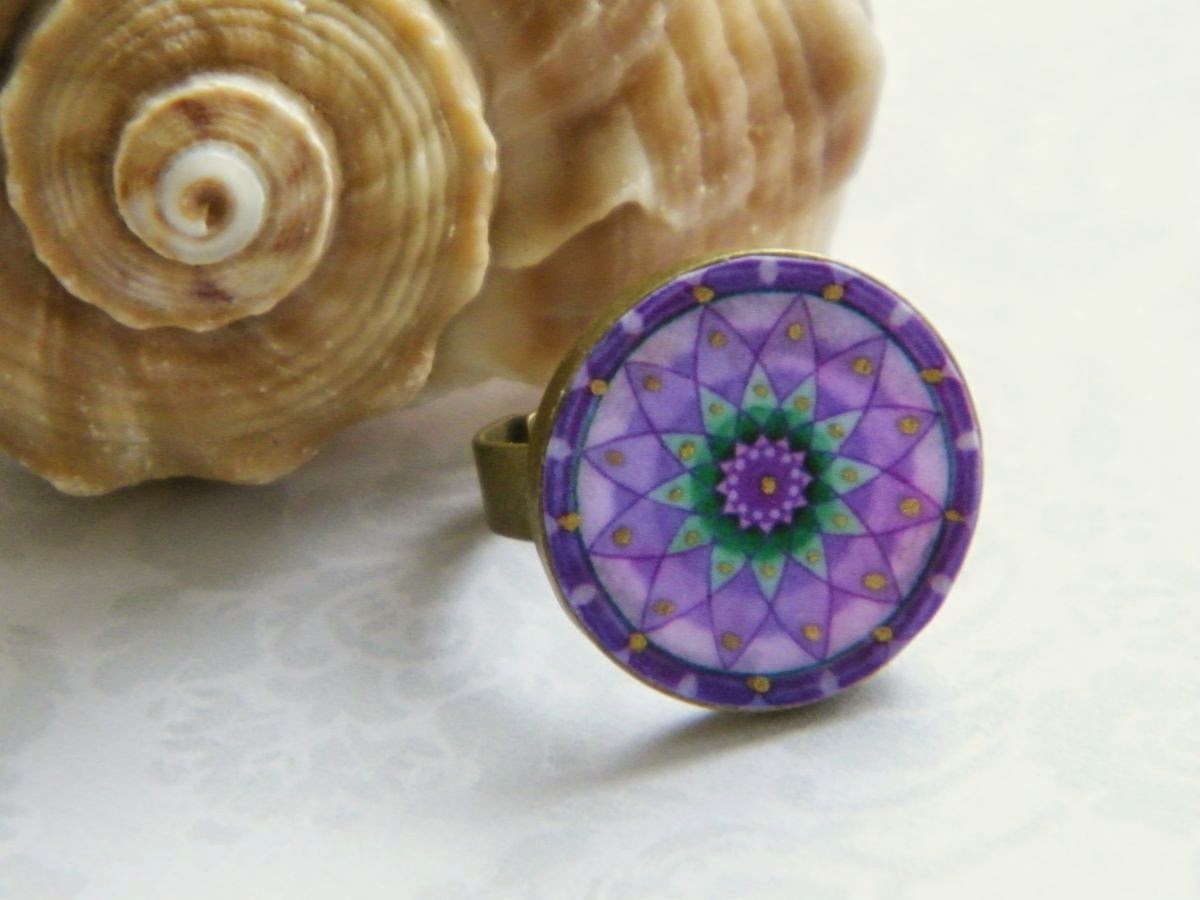
Mandala ring with Green star mandala


Green star Mandala ring


Mandala earrings with Red sky flower mandala


Red sky flower Mandala earrings


Red flower Mandala earrings.

Mandala earrings in vintage style have made by me with lot of love.

Beautiful antique bronze earrings features a image of my original drawing Mandala.


Friday, April 11, 2014

Mandala talisman with Mystical mandala


Mystical Mandala talisman


Mystical mandala

Acryl on paper


Thursday, April 10, 2014

Amulet


Amulet


An amulet (Latin amuletum) can be any object but its most important characteristic is its alleged power to protect its owner from danger or harm. Amulets are different from talismans as a talisman is believed to bring luck or some other benefit, though it can offer protection as well. Amulets are often confused with pendants—charms that hang from necklaces—any given pendant may indeed be an amulet, but so may any other charm which purports to protect its owner from danger.

Potential amulets include gems, especially engraved gems, statues, coins, drawings, pendants, rings, plants and animals; even words in the form of a magical spell or incantation to repel evil or bad luck.

The word "amulet" comes from the Latin amuletum; the earliest extant use of the term is in Pliny's Natural History, meaning "an object that protects a person from trouble".

DuneArt

Wednesday, April 9, 2014

Saturday, April 5, 2014

Mandala amulet with Second chakra mandala


Second Chakra Mandala amulet


Print of original Mandala painting in vintage pendant.

This is Second Chakra Mandala.

Necklace is amulet too.


Swadhisthana is described as a black lotus, with six vermillion-colored petals which have the following syllables written on them in the colour of lightning: बं baṃ, भं bhaṃ, मं maṃ, यं yaṃ, रं raṃ and लं laṃ.
Inside this lotus is a white crescent moon, formed by two different sized inner circles, one inside the other. The crescent moon is the water region presided over by Varuna, who is white in color, four-armed, holds a noose and is seated on a crocodile. The two inner circles also have petals; the larger one eight outward facing petals, and the smaller one eight inward facing petals.
The seed mantra, located in the innermost circle, is a moon-white वं vaṃ. Within the bindu, or dot, above the mantra is the deity Vishnu. He is dark blue, wears a yellow dhoti, and holds a conch, a mace, a wheel and a lotus. He wears the shriwatsa mark, and the koustabha gem. He is seated either on a pink lotus, or on the divine eagle Garuda. His Shakti is the goddess Rakini (or Chakini). She is black, dressed in red or white, seated on a red lotus. She is either one faced and two armed, holding a sword and a shield, or two faced and four armed, holding a trident, lotus, drum and vajra, or an arrow, skull, drum and axe.

The six petals represent the following modes of consciousness, also known as vrittis: affection, pitilessness, feeling of all-destructiveness, delusion, disdain and suspicion.
Swadhisthana is associated with the unconscious, and with emotion. It is closely related to the Muladhara in that Swadhisthana is where the different samskaras (potential karmas), lie dormant, and Muladhara is where these samskaras find expression. It is associated with the element of water, the sense of taste, and the act of procreation.
Swadhisthana contains unconscious desires, especially sexual desire, and it is said, to raise the kundalini shakti (energy of consciousness) above Swadhisthana is extremely difficult for this reason. Many saints have had to face the sexual temptations associated with this chakra.
One who meditates on Swadhisthana is believed to obtain the following siddhis or occult powers: freedom from enemies; the status of a lord among yogis; eloquence and clarity (words flowing like nectar in well-reasoned discourse); loss of fear of water; awareness of astral entities; and the ability to taste anything desired for oneself or others.


Friday, April 4, 2014

Music relaxation


Beautiful music for meditation


…the glow produced by a state of total awareness, is seen as a burst of incandescence in the entire luminous egg. It is an explosion of light of such a magnitude that the boundaries of the shell are diffused and the inside emanations extend themselves beyond…For seers, this is the moment when they burn from within…And in full awareness they fuse themselves to the emanations at large, and glide into eternity.
- don Juan Matus

Igniting ‘the fire from within,’ burning with a glow of awareness inside, is the moment when all of the inter-connecting parts of ourselves – our minds, bodies, emotions, and spirits – fuse in a single, luminous burst of cohesion, propelling us into infinity. And in preparation for this culminating event, the ancients sought to experience their ‘internal fire burning within’ – in their passion for living during their earth-walk, in all aspects of their lives.
Our ancestors watched the moon and galaxies move across the night sky, and daringly laid out their cities and planned their migrations based upon their observations. They noticed how many days of sun were followed by how many days of rain and then sun again, and, guided only by their internal knowing, measured the seasons in months and determined when to plant and harvest. They paid attention to the cycles of sun, Earth and Moon, light and dark, and developed, without precedent, a twenty-four hour system of marking time.
Creatively living lives inspired by the earth and its wonders, those seers shared in the earth’s emanations. They aligned their minds, bodies, emotions and spirits, igniting the emanations they shared with the earth, much like the way air, matter, water, and heat mix to fire the earth’s core, and swam amidst the earth’s currents, receiving and feeling its energetic boost.
This endeavor remains possible today. Knowing our daily cycle of when we ‘simmer with passion within’ and when we don’t, within the cycle of the earth’s light and dark, activity and calm, gives us the power to creatively live and manifest our most longed-for dreams with the ‘spark of presence’ — our ability to bring our best selves to the situation at hand.
And so we must ask ourselves: Do we know when our minds, bodies, emotions and spirits come into alignment, glowing with fervor, and when they calm and cool? Are we aware at which part of the day, afternoon or night we ‘glimmer from within’ and when we ‘cool off?’ And if we are aware of this flow – do we plan our physical activity when we are most physically adept, our work projects and decision-making when most mentally alert, our time with loved ones and friends when emotionally available, our deepest connection with spirit when most inspired, and our sleep and nurturance when we naturally relax?
Aligning ourselves in this way, choosing to live within our own internal cycle of fire and calm in alignment with the earth’s cycle, saves us energy. We may no longer find ourselves running breathlessly after every invitation, saying ‘yes’ out of duty, guilt, or the search for approval or affection. Similarly, we may find ourselves no longer saying ‘no’ to important possibilities, because of lack of energy, being unprepared, and possible fear of failure or looking foolish. Instead, we can develop seers’ impeccability — the art of knowing and checking in with ourselves and our internal rhythm, and deciding when in our days, in our lives, is our best time to act, refrain, share and exude with others, and rest.

Vintage Gaudy Mandala


Vintage Gaudy Mandala


Original Gaudy Mandala put on antique paper.


Ethno Mandala necklace


Ethno Mandala necklace


This unique Mandala necklace has made by me with a lot of love and care.

The pendant measures are 1,9 inch ( 4,8 cm ) round and is hung on an 20 inch ( 50 cm ) black satin ribbon.

Pendant is created with a antique metal base and my original artwork.

Artwork is printed on high quality photo paper which is protected by resin glaze.


Friday, January 17, 2014

Thursday, January 16, 2014

Tuesday, December 3, 2013

Meditation Mandala


Meditation Mandala
Acryl on paper


Gaudy flower Mandala


Gaudy flower Mandala
Acryl on paper


About abstract art


Abstract art


Abstract art uses a visual language of form, color and line to create a composition which may exist with a degree of independence from visual references in the world. Western art had been, from the Renaissance up to the middle of the 19th century, underpinned by the logic of perspective and an attempt to reproduce an illusion of visible reality. The arts of cultures other than the European had become accessible and showed alternative ways of describing visual experience to the artist. By the end of the 19th century many artists felt a need to create a new kind of art which would encompass the fundamental changes taking place in technology, science and philosophy. The sources from which individual artists drew their theoretical arguments were diverse, and reflected the social and intellectual preoccupations in all areas of Western culture at that time.
Abstract art, nonfigurative art, nonobjective art, and nonrepresentational art are loosely related terms. They are similar, but perhaps not of identical meaning.
Abstraction indicates a departure from reality in depiction of imagery in art. This departure from accurate representation can be slight, partial, or complete. Abstraction exists along a continuum. Even art that aims for verisimilitude of the highest degree can be said to be abstract, at least theoretically, since perfect representation is likely to be exceedingly elusive. Artwork which takes liberties, altering for instance color and form in ways that are conspicuous, can be said to be partially abstract. Total abstraction bears no trace of any reference to anything recognizable. In geometric abstraction, for instance, one is unlikely to find references to naturalistic entities. Figurative art and total abstraction are almost mutually exclusive. But figurative and representational (or realistic) art often contains partial abstraction.
Both geometric abstraction and lyrical abstraction are often totally abstract. Among the very numerous art movements that embody partial abstraction would be for instance fauvism in which color is conspicuously and deliberately altered vis-a-vis reality, and cubism, which blatantly alters the forms of the real life entities depicted.


Delaunay-Windows.jpg

Friday, November 8, 2013

Mandala gallery eighteen


Mandala gallery


Violet sky Mandala
Acryl on paper


Bird of paradise Mandala
Acryl on paper


Night sky Mandala


New Mandala


Night sky Mandala
Acryl and water-colors

Thursday, October 24, 2013

Zendala and Zentangles


Zendala


For ages, artists have known intuitively what modern healers are just beginning to recognize; creating an image on paper or canvas, with words, clay or other medium, can foster physical and emotional healing and growth for both the creator and viewer. Science has revealed that healing emotional wounds, creating healthy and whole emotional well being heals the physical body. Extensive research in the fields of split-brain functioning, visualization and psychoneuroimmunology has shown that art is a powerful healing tool that can be used by anyone, even those without artistic ability.

Zendala/Zentangle is nothing more than a structured and contained doodle. Free from the pressures of creating something tangent, Zentangles/Zendalas are intuitive art, conducive to meditation and spiritual connection.

Zentangle is an easy to learn method of creating beautiful images from repetitive patterns. It is a fascinating new art form that is fun and relaxing. It increases focus and creativity. Zentangle provides artistic satisfaction and an increased sense of personal well being. Zentangle is enjoyed by a wide range of skills and ages and is used in many fields of interest.


Characteristics of Zentangle


Intuitive Artform
With Zentangle, anyone can create beautiful images from repetitive patterns. This method is easy to learn and easy to do. And even though it is a specified series of steps, it results in a creative expression that transcends its own rules.
Fun and Relaxing
Zentangle provides a fun and lighthearted way to relax and intentionally facilitate a shift in focus and perspective. Zentangle is unencumbered by dogma and cost which can weigh on other approaches. Nevertheless, Zentangle is sufficiently structured and organized so you can enjoy and benefit from an activity that otherwise might be considered whimsical.
Abstract
You cannot fail to create a Zentangle. That is because a Zentangle is meant to look like a Zentangle. It does not need to look like anything else and has no up or down.
Unexpected Results
Zentangle is an unusual approach to art because you have no idea what its result will be when you begin. Your creation is not restricted by your expectations.
Ceremonial
Zentangle is an artistic meditation that supports relaxation, focus and inspiration and can be a wonderful daily ritual. Zentangle's philosophy, symbolism and metaphor is elegant and profound. There is much to discover about life and one's self through this simple act.
Timeless
Creating designs, manipulating symbols and putting pen to paper is part of our human heritage. In a time of keyboards, computer mice, and cell phones, Zentangle allows a return to a comfort and familiarity of timeless, basic creativity.
Portable
Zentangle provides an easy to learn method of relaxed focus which can be done almost anywhere, alone or in groups, without any special abilities or costly equipment.
Quality
Zentangle is elegantly designed, crafted and presented. If you are going to do something, then do it with the finest tools and materials available. We use the best paper and pens available to ensure your Zentangles will be a respected and treasured work of art. Unlike other methods of relaxation and focus, Zentangle yields a fruit which is beautiful and can be appreciated, collected, chronicled and reflected upon for years to come. Using fine materials is an act of respect for yourself and respect for your art.
Non Technical
Zentangle is not limited by technology. Your creativity is not directed by how someone else wrote a particular program, nor does it need batteries or electricity. Zentangle provides a counterbalance to our increasing use of computers, mice, screens and keyboards. It returns us to that fundamentally human behavior of manipulating symbols and putting marks on paper. Zentangle is not pre-programmed. Your creativity is your only limit and Zentangle has a way of increasing and inspiring expression of your personal creativity.
Empowering
To learn that you can deliberately relax and intentionally direct your attention while creating beautiful works of art is an empowering and uplifting experience.
Benefits and Uses of Zentangle
It is fascinating to learn how other people are using Zentangle. Here's a list of ways others are enjoying Zentangle's benefits. 

This list continues to grow as people apply Zentangle in ways we never considered.


  •  Relaxation
  • Journalling
  • Insomnia (Improved sleep by creating a Zentangle before bedtime)
  • Self-esteem
  • Inspiration
  • Panic attacks (For fear of flying, creating a Zentangle during takeoff and landing)
  • Modify behavior
  • Create beautiful works of art
  • Nurture and develop creative abilities
  • Relieve stress
  • Improve eye/hand coordination
  • Develop/rehabilitate fine motor skills
  • Team building and group focus
  • Therapy
  • Anger management
  • Addiction therapy tool
  • Early artist development and appreciation
  • Increase attention span and ability to concentrate
  • Home schooling
  • Design inspiration
  • Stretching and warm-up for artists
  • Stress reduction


Symbolism of butterfly


Symbolic meanings of butterfly


The butterfly is a symbol of transformation because of its impressive process of metamorphosis. 
From egg to caterpillar to pupa, and from the cocoon the butterfly emerges in its unfurling glory
We can relate the butterfly's stages of life to our own life-phases...growing pains, times of ravenous hunger, times of vulnerability, moments of miraculous expansion. 
In many cultures the butterfly is associated with the soul. 
Christianity considers the butterfly as a symbol for the soul. 
To wit, the butterfly is depicted on ancient Christian tombs, as Christ has been illustrated holding a butterfly in Christian art. 
Olso, the butterfly can represents time, grace, growth, elegance, transition, expansion, surrender, lightness, expression, resurrection and vulnerability.


Butterfly in Mandala


 Native butterfly Mandala  
Acryl on paper

Wednesday, October 23, 2013

Meaning of Colors of the Aura


Colors of the Aura


Purple color: indicates spiritual thoughts. Purple is never a strong point in the Aura. It appears only as temporary "clouds" and "flames", indicating truly spiritual thoughts.

Blue color: balanced existence, sustaining life, eased nerve system, transmitting forces and energy. People with blue strong point in their Aura are relaxed, balanced and feel ready to live in a cave and survive. They are born survivors. Blue thought is a thought about relaxing the nerve system to achieve the balance of the mind or a thought about surviving. Electric blue can override any other color in the Aura, when the person is receiving and/or transmitting information in a telepathic communication.

Turquoise color: indicates dynamic quality of being, highly energized personality, capable of projection, influencing other people. People with turquoise strong point in their Aura can do many things simultaneously and are good organizers. They feel bored when forced to concentrate on one thing. People love bosses with turquoise Auras, because such bosses explain their goals and influence their team rather than demand executing their commands. Turquoise thought is a thought about organizing and influencing others.

Green color: restful, modifying energy, natural healing ability. All natural healers should have it. People with a green strong point in their Auras are natural healers. The stronger the green Aura, the better the healer. They also love gardening and usually have a "green hand" - anything grows for them. Being in a presence of a person with a strong and green Aura is a very peaceful and restful experience. Green thought indicates a restful state and healing.

Yellow
color: joy, freedom, non-attachment, freeing or releasing vital forces. People who glow yellow are full of inner joy, very generous and not attached to anything. Yellow halo around the head: high spiritual development. A signature of a spiritual teacher. Do not accept spiritual teachings from anyone who does not have such a yellow halo. Buddha and Christ had yellow halos extending to their arms. Today it is rare on Earth to find a person with a halo larger than 1 inch. Yellow halo appears as a result of a highly active brow chakra (which can be seen glowing with violet by many people at my workshops). Highly spiritual people stimulate the brow chakra continuously for many years, because they always have intensive spiritual thoughts in their minds. When this chakra is observed when highly active, a yellow (Auric pair) halo appears around it, surrounding the entire head. Yellow thought indicates a moment of joy and contentment.

Orange
color: uplifting and absorbing. Inspiring. A sign of power. Ability and/or desire to control people. When orange becomes a strong point, it usually contributes to a yellow halo, which then becomes gold, indicating not only a spiritual teacher, but a powerful spiritual teacher, someone capable of demonstrating his/her unique abilities. Orange thought is a thought about exercising power or a desire to control people.

Red
color: materialistic thoughts, thoughts about the physical body. Predominantly red Aura indicates materialistically oriented person.

Pink
color : love (in a spiritual sense). To obtain a clean pink, you need to mix the purple (the highest frequency we perceive) with red (the lowest frequency). Pink Aura indicates that the person achieved a perfect balance between spiritual awareness and the material existence. The most advanced people have not only a yellow halo around the head (a permanent strong point in the Aura) but also a large pink Aura extending further away. The pink color in the Aura is quite rare on Earth and appears only as a temporary thought, never as a strong point in the Aura.

White color: serious disease, artificial stimulation (drugs). Why does the white color in the Aura indicate problems? White color is like a noise, rather than a set of harmonious tones (monochromatic colors). It is impossible to "tune" the noise to an orchestra playing harmonious music, hence the white Aura indicates a lack of harmony in the body and mind. Nature, which we are a part of, is harmonious. This harmony comes in discrete vibration "tones" or harmonics, partially described by the modern quantum physics.


Monday, April 29, 2013

Bird of paradise Mandala


New Mandala

Bird of paradise Mandala
Acryl on paper


Wednesday, April 17, 2013

Zendala


Zendala


Violet water Zendala
Acryl on paper