Mandala,mandala gallery,art pillows,mugs,art lamp,notebook,ceramic ornament,art towels,art candles,tapestry,what are mandalas,mandala project,mandala coloring,new mandalas, mandala designs,mandala art,printable mandala,free mandala,the mandala, color mandala,what is a mandala,mandala,the artist gallery,abstract paintings,vintage paintings,photofraphies,famous paintings,graphites,budhism,meditation,about color,alternative,famous quotes,ancient mandala,jewelry,art,reproductions....
Pages
- Home
- Mandala gallery
- Mandala art
- Art on the wall
- Mandala on canvas
- Mandala jewelry
- Fine Art America
- Abstract paintings
- Vintage Mandala
- Personal Mandala
- Mandala art
- What is Mandala?
- Meditation books
- Inspiration quotes
- Flower Mandalas
- Poster
- Tibetan mandalas
- Sri Yantra mandalas
- Chakra Mandalas
- Earrings
- Necklaces
- Rings
- Bracelets
- Buddha paintings
- Free Mandala
- What are mandalas?
- Art
- Symbolism
- Abstract art
- Links
Wednesday, July 23, 2014
Thursday, July 10, 2014
Cultural history of lucid dreaming
Lucid dreaming through the history
Even though it has only come to the attention of the general
public in the last few decades, lucid dreaming is not a modern
discovery. Lucid dreaming is the western term used to denote a
practice similar to Yoga
nidra. The distinguishing difference is the degree to which one
remains cognizant of the actual physical environment as opposed to a
dream environment. In lucid dreaming, we are only (or mainly)
cognizant of the dream environment, and have little or no awareness
of our actual environment. The concept of Yoga nidra is very ancient
in Indian traditions such as Hinduism and Buddhism. Krishna
is often associated with Yoga nidra in epic Mahabharata.
Similarly, many yogis and rishis are supposed to have experienced
Yoga nidra throughout their life. In modern times, Yoga nidra was
experienced by Swami
Satyananda Saraswati[citation
needed] when he was living with his guru Swami
Sivananda in Rishikesh. He began studying the tantric scriptures
and, after practice, constructed a system of relaxation, which he
began popularizing in the mid 20th century. He explained yoga nidra
as a state of mind between wakefulness and sleep that opened deep
phases of the mind, suggesting a connection with the ancient tantric
practice called nyasa, whereby Sanskrit
mantras are
mentally placed within specific body parts, while meditating on each
part (of the bodymind).
The form of practice taught by Swami Satyananda includes eight stages
(Internalisation, Sankalpa, Rotation of Consciousness, Breath
Awareness, Manifestation of Opposites, Creative Visualization,
Sankalpa and Externalisation).
Also, in early Buddhism
it was a common practice among people in the monastic community. As
preserved in the ancient Sarvastivada
school's Sutra on Mindfulness
of the Body in the Madhayama agama (equivalent of Pali Kayagatasati)
it states that monks and nuns under practice should be 'Understanding
(having awareness in) the four postures and states of being asleep or
awake'. Documented since the 8th century, Tibetan
Buddhists and Bonpo
were practicing a form of dream
yoga held to maintain full waking consciousness while in the
dream state. One important message of the book is the distinction
between the Dzogchen
meditation of awareness and dream yoga. The Dzogchen
awareness meditation has also been referred to by the terms
rigpa awareness, contemplation, and presence.
Awareness during the sleep and dream states is associated with
the Dzogchen practice of natural light. This practice only
achieves lucid dreams as a secondary effect—in contrast to dream
yoga, which aims primarily at lucid dreaming. According to Buddhist
teachers, the experience of lucidity helps us understand the
unreality of phenomena, which would otherwise be overwhelming during
dream or the death experience.
In Western culture, the phenomenon had been referred to by Greek
philosopher Aristotle
who had written: "often when one is asleep, there is something
in consciousness which declares that what then presents itself is but
a dream". Also in a letter written by St.
Augustine of Hippo in 415 AD about a story of a dreamer, Doctor
Gennadius, refers to lucid dreaming. The dreamer reported that he
didn't realize he was in the dream world but the man whom he met in
his dream reminded him about this and pointed out that his experience
was a proof of life after death.
An early recorded lucid dreamer was the philosopher and physician
Sir Thomas
Browne (1605–1682). Browne was fascinated by the world of
dreams and described his own ability to lucid dream in his Religio
Medici: "...yet in one dream I can compose a whole
Comedy, behold the action, apprehend the jests and laugh my self
awake at the conceits thereof". Similarly, Samuel
Pepys in his diary entry for 15
August 1665 records a dream "that I had my Lady Castlemayne
in my arms and was admitted to use all the dalliance I desired with
her, and then dreamt that this could not be awake, but that it was
only a dream". Marquis
d'Hervey de Saint-Denys argued that it is possible for anyone to
learn to dream consciously. In 1867, he published his book Les
Rêves et les moyens de les diriger; observations pratiques
("Dreams and How to Guide them; Practical Observations"),
in which he documented more than twenty years of his own research
into dreams.
The term lucid dreaming was coined by Dutch
author and psychiatrist
Frederik
van Eeden in his 1913 article "A Study of Dreams".
This paper was highly anecdotal and not embraced by the scientific
community. Some consider this a misnomer because it means much more
than just "clear or vivid" dreaming. The alternative term
conscious dreaming avoids this confusion. However, the term
lucid was used by van Eeden in its sense of "having
insight", as in the phrase a lucid interval applied to
someone in temporary remission from a psychosis,
rather than as a reference to the perceptual quality of the
experience, which may or may not be clear and vivid.
In the 1950s, the Senoi
hunter-gatherers of Malaysia
were reported to make extensive use of lucid dreaming to ensure
mental health, although later studies refuted these claims.
A 2012 report by the BBC
claimed that "interest in lucid dreaming has grown in recent
years", and corroborated this with examples of the many
smartphone apps
that exist to help people experience the phenomenon. One such app was
downloaded half a million times in six weeks, the report says.
Monday, July 7, 2014
Thursday, May 22, 2014
Friday, May 16, 2014
Tuesday, April 22, 2014
Sunday, April 20, 2014
Friday, April 18, 2014
Friday, April 11, 2014
Thursday, April 10, 2014
Amulet
Amulet
An amulet (Latin amuletum) can be any object but its most important characteristic is its alleged power to protect its owner from danger or harm. Amulets are different from talismans as a talisman is believed to bring luck or some other benefit, though it can offer protection as well. Amulets are often confused with pendants—charms
that hang from necklaces—any given pendant may indeed be an amulet, but
so may any other charm which purports to protect its owner from danger.
Potential amulets include gems, especially engraved gems, statues, coins, drawings, pendants, rings, plants and animals; even words in the form of a magical spell or incantation to repel evil or bad luck.
The word "amulet" comes from the Latin amuletum; the earliest extant use of the term is in Pliny's Natural History, meaning "an object that protects a person from trouble".
DuneArt
DuneArt
Wednesday, April 9, 2014
Sunday, April 6, 2014
Saturday, April 5, 2014
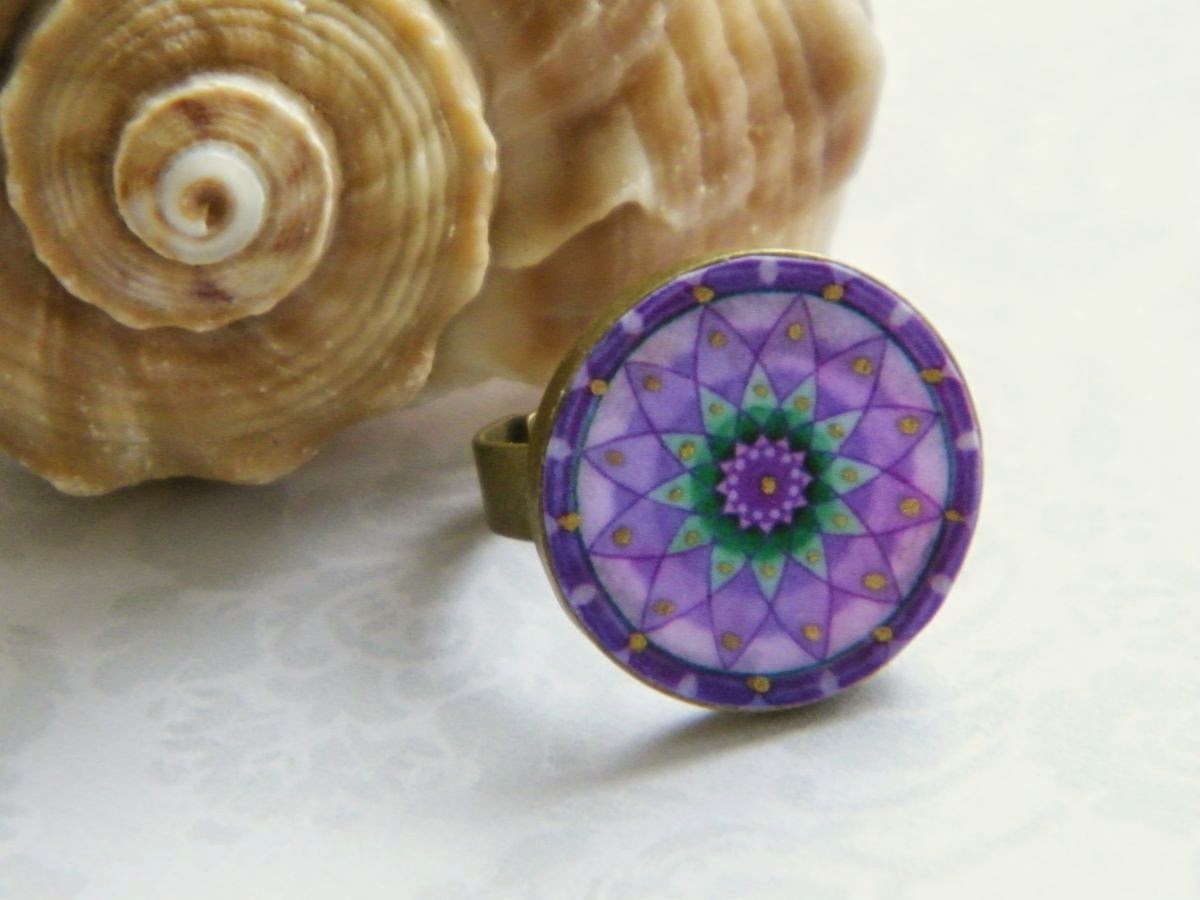
Mandala amulet with Second chakra mandala
Second Chakra Mandala amulet
Print of original Mandala painting in vintage pendant.
This is Second Chakra Mandala.
Necklace is amulet too.
Swadhisthana is described as a black lotus, with six vermillion-colored petals which have the following syllables written on them in the colour of lightning: बं baṃ, भं bhaṃ, मं maṃ, यं yaṃ, रं raṃ and लं laṃ.
Inside this lotus is a white crescent moon, formed by two different sized inner circles, one inside the other. The crescent moon is the water region presided over by Varuna, who is white in color, four-armed, holds a noose and is seated on a crocodile. The two inner circles also have petals; the larger one eight outward facing petals, and the smaller one eight inward facing petals.
The seed mantra, located in the innermost circle, is a moon-white वं vaṃ. Within the bindu, or dot, above the mantra is the deity Vishnu. He is dark blue, wears a yellow dhoti, and holds a conch, a mace, a wheel and a lotus. He wears the shriwatsa mark, and the koustabha gem. He is seated either on a pink lotus, or on the divine eagle Garuda. His Shakti is the goddess Rakini (or Chakini). She is black, dressed in red or white, seated on a red lotus. She is either one faced and two armed, holding a sword and a shield, or two faced and four armed, holding a trident, lotus, drum and vajra, or an arrow, skull, drum and axe.
The six petals represent the following modes of consciousness, also known as vrittis: affection, pitilessness, feeling of all-destructiveness, delusion, disdain and suspicion.
Swadhisthana is associated with the unconscious, and with emotion. It is closely related to the Muladhara in that Swadhisthana is where the different samskaras (potential karmas), lie dormant, and Muladhara is where these samskaras find expression. It is associated with the element of water, the sense of taste, and the act of procreation.
Swadhisthana contains unconscious desires, especially sexual desire, and it is said, to raise the kundalini shakti (energy of consciousness) above Swadhisthana is extremely difficult for this reason. Many saints have had to face the sexual temptations associated with this chakra.
One who meditates on Swadhisthana is believed to obtain the following siddhis or occult powers: freedom from enemies; the status of a lord among yogis; eloquence and clarity (words flowing like nectar in well-reasoned discourse); loss of fear of water; awareness of astral entities; and the ability to taste anything desired for oneself or others.
Friday, April 4, 2014
Music relaxation
Beautiful music for meditation
…the glow produced by a state of total awareness, is seen as a burst of incandescence in the entire luminous egg. It is an explosion of light of such a magnitude that the boundaries of the shell are diffused and the inside emanations extend themselves beyond…For seers, this is the moment when they burn from within…And in full awareness they fuse themselves to the emanations at large, and glide into eternity.
- don Juan Matus
Igniting ‘the fire from within,’ burning with a glow of awareness inside, is the moment when all of the inter-connecting parts of ourselves – our minds, bodies, emotions, and spirits – fuse in a single, luminous burst of cohesion, propelling us into infinity. And in preparation for this culminating event, the ancients sought to experience their ‘internal fire burning within’ – in their passion for living during their earth-walk, in all aspects of their lives.
Creatively living lives inspired by the earth and its wonders, those seers shared in the earth’s emanations. They aligned their minds, bodies, emotions and spirits, igniting the emanations they shared with the earth, much like the way air, matter, water, and heat mix to fire the earth’s core, and swam amidst the earth’s currents, receiving and feeling its energetic boost.
This endeavor remains possible today. Knowing our daily cycle of when we ‘simmer with passion within’ and when we don’t, within the cycle of the earth’s light and dark, activity and calm, gives us the power to creatively live and manifest our most longed-for dreams with the ‘spark of presence’ — our ability to bring our best selves to the situation at hand.
And so we must ask ourselves: Do we know when our minds, bodies, emotions and spirits come into alignment, glowing with fervor, and when they calm and cool? Are we aware at which part of the day, afternoon or night we ‘glimmer from within’ and when we ‘cool off?’ And if we are aware of this flow – do we plan our physical activity when we are most physically adept, our work projects and decision-making when most mentally alert, our time with loved ones and friends when emotionally available, our deepest connection with spirit when most inspired, and our sleep and nurturance when we naturally relax?
Aligning ourselves in this way, choosing to live within our own internal cycle of fire and calm in alignment with the earth’s cycle, saves us energy. We may no longer find ourselves running breathlessly after every invitation, saying ‘yes’ out of duty, guilt, or the search for approval or affection. Similarly, we may find ourselves no longer saying ‘no’ to important possibilities, because of lack of energy, being unprepared, and possible fear of failure or looking foolish. Instead, we can develop seers’ impeccability — the art of knowing and checking in with ourselves and our internal rhythm, and deciding when in our days, in our lives, is our best time to act, refrain, share and exude with others, and rest.
Ethno Mandala necklace
This unique Mandala necklace has made by me with a lot of love and care.
The pendant measures are 1,9 inch ( 4,8 cm ) round and is hung on an 20 inch ( 50 cm ) black satin ribbon.
Pendant is created with a antique metal base and my original artwork.
Artwork is printed on high quality photo paper which is protected by resin glaze.
The pendant measures are 1,9 inch ( 4,8 cm ) round and is hung on an 20 inch ( 50 cm ) black satin ribbon.
Pendant is created with a antique metal base and my original artwork.
Artwork is printed on high quality photo paper which is protected by resin glaze.
Friday, January 17, 2014
Thursday, January 16, 2014
Tuesday, December 3, 2013
About abstract art
Abstract art
Abstract art uses a visual
language of form, color and line to create a composition which
may exist with a degree of independence from visual references in the
world.
Western art
had been, from the Renaissance
up to the middle of the 19th century, underpinned by the logic of
perspective
and an attempt to reproduce an illusion of visible reality. The arts
of cultures other than the European had become accessible and showed
alternative ways of describing visual experience to the artist. By
the end of the 19th century many artists felt a need to create a new
kind of art which would encompass the fundamental changes taking
place in technology, science and philosophy. The sources from which
individual artists drew their theoretical arguments were diverse, and
reflected the social and intellectual preoccupations in all areas of
Western culture at that time.
Abstract art, nonfigurative art, nonobjective art, and
nonrepresentational art are loosely related terms. They are similar,
but perhaps not of identical meaning.
Abstraction indicates a departure from reality in depiction of
imagery in art. This
departure from accurate representation can be slight, partial, or
complete. Abstraction exists along a continuum. Even art that aims
for verisimilitude of the highest degree can be said to be abstract,
at least theoretically, since perfect representation is likely to be
exceedingly elusive. Artwork which takes liberties, altering for
instance color and form in ways that are conspicuous, can be said to
be partially abstract. Total abstraction bears no trace of any
reference to anything recognizable. In geometric
abstraction, for instance, one is unlikely to find references to
naturalistic entities. Figurative
art and total abstraction are almost mutually
exclusive. But figurative
and representational
(or realistic)
art often contains partial abstraction.
Both geometric
abstraction and lyrical
abstraction are often totally abstract. Among the very numerous
art movements
that embody partial abstraction would be for instance fauvism
in which color is conspicuously and deliberately altered vis-a-vis
reality, and cubism,
which blatantly alters the forms of the real life entities
depicted.
Subscribe to:
Posts (Atom)